
Westpac
OPA Conversation tool
The OPA platform design seeks to meet the above objectives via a scalable design model that takes into account the needs of customers, bankers and business.
Objective
Bank customers wanted a more thorough understanding and transparencies for the advices and services that they receive from the bank, they wanted to feel that their needs were being understood, relating to any product or services that they were given, before committing to any financial decision. Under the requirement of banking service regulation, it was asked by ASIC that all conversations between customers and the banking service providers has be documented, following particular rules and steps, in order to be compliant. Westpac needed a time-effective and seamless way to document the conversation between bankers and customers, previously the banking representatives had to utilise 17 systems, while facilitating a service, while having a face to face conversation with the time-poor customers.
In order to have a holistic understanding of the banking services, business needs and discover opportunities and gaps in the current landscape, we completed 4 rounds of interviews and tested with
10 bankers, 47 customers, undertook 23 workshops and spoke to the following key stakeholders: Compliance lead from the Legal team, Brand directors from the 4 Westpac retail banks, IT and Oracle solution architects.
Design Principles
Throughout the design and testing of the OPA prototype we adhered to the following design principles:
Compliance
Capture the required information to support Westpac’s compliance obligations around Responsible lending, Basic Banking, General Insurance & Wealth.
Efficiency
Minimal effort required for bankers to complete discussions during or post conversation with a customer.
Side-by-side
Designed to be viewed by the customer and the banker side by side, aiding a natural, transparent conversation that delivers on the customer's needs and empowers them to explore further interests and opportunities.
Accomodate multiple pathways
Facilitate a nonlinear conversation that can loop through customers’ interests, allowing a natural and easy transition between OPA and other systems and applications within the organisation.
Uncover expressed & unexpressed needs
Designed to help bankers thoroughly uncover customers’ needs, based on knowledge they find out about the customer(s) and their specific circumstances, in order to provide their best recommendation, or direct them to meet with other experts across disciplines.Accommodate multiple pathways
Facilitate a nonlinear conversation that can loop through customers’ interests, allowing a natural and easy transition between OPA and other systems and applications within the organisation.
We applied a four phase approach to each product need tested:
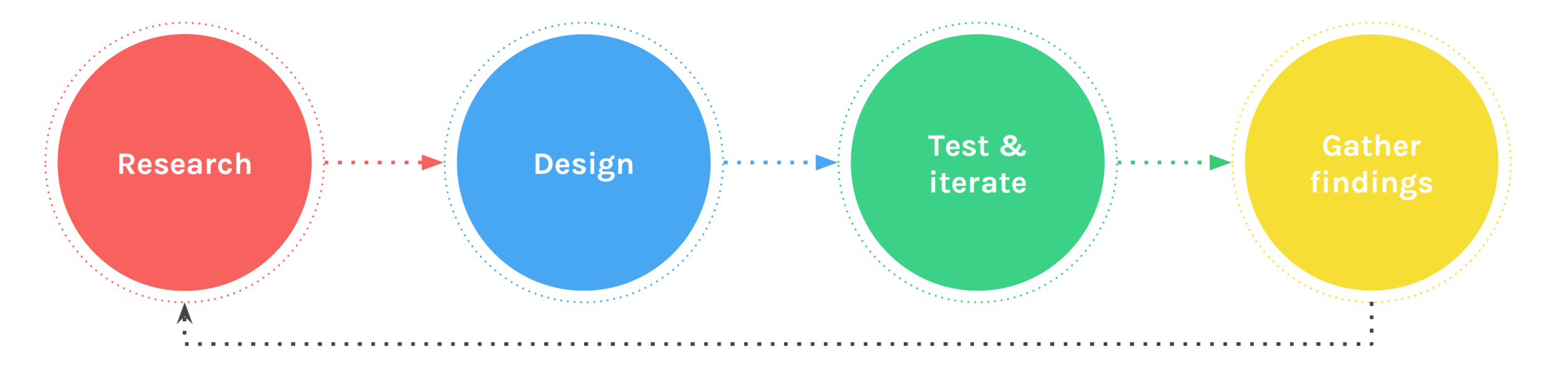
Research:
Banker & project team workshops to capture business requirements, limitations and system capability.
Design:
Create initial solution to formulate hypotheses.
Test and iterate:
Prototype testing with bankers and customers.
Gather findings:
Collate feedback from bankers, customers and stakeholders to inform final design.
47 Customers
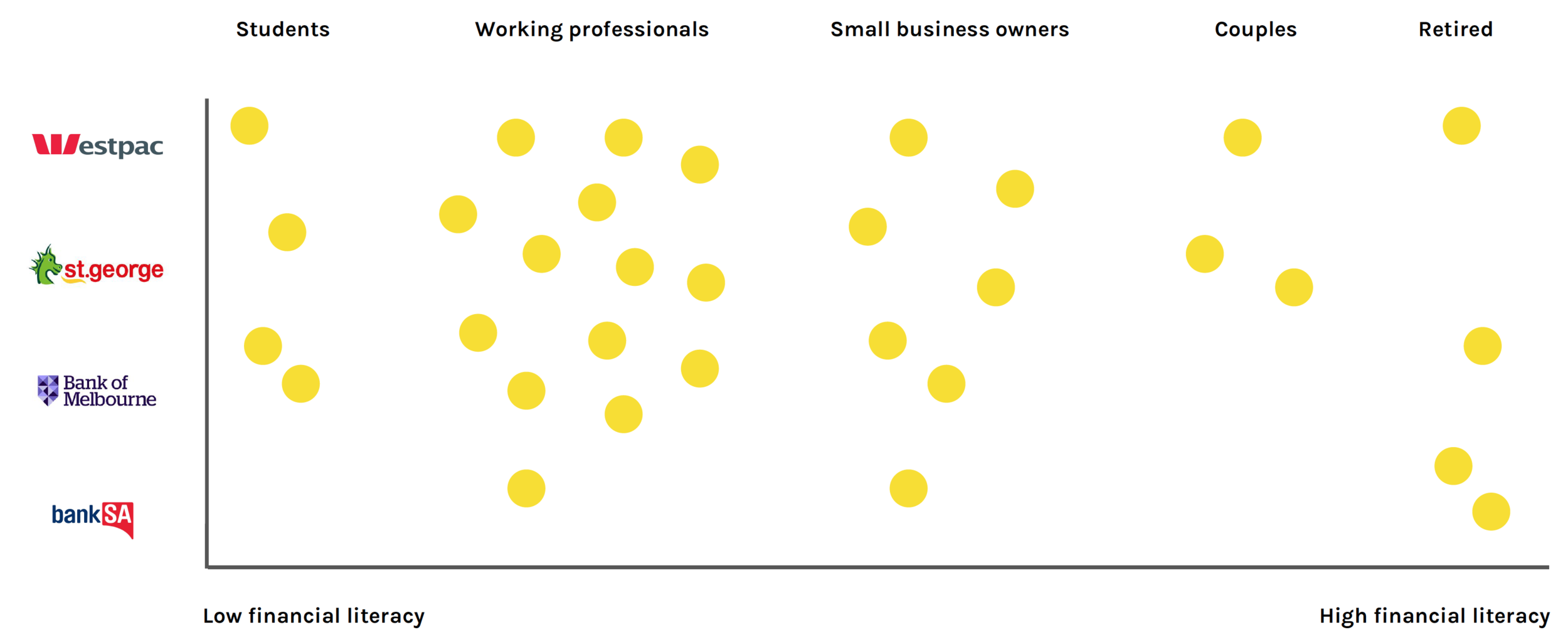
In order to understand how customers feel about the exisiting banking services, and the needs of them in the new platform, we recruited customers of different ages, professions and varying degrees of financial literacy so that we were able to test a wide variety of banking products, services and scenarios with the most relevant audience.
10 Bankers
We tested the new design prototype with a range of bankers from different brands, levels and specialities to capture relevant feedbacks in accordance with the product needs and advice pathways we wanted to test. We engaged with Branch Managers, Customer Service Specialist, and Learning & development from Westpac, Bank of Melbourne, Bank SA and St George Bank.
4 Brands
This new conversation tool is designed and going to be used by the 4 banks under Westpac Group, during all the personal banking conversation, including basic banking, insurance, responsible lending and wealth.
Testing with Banker & Customer side by side
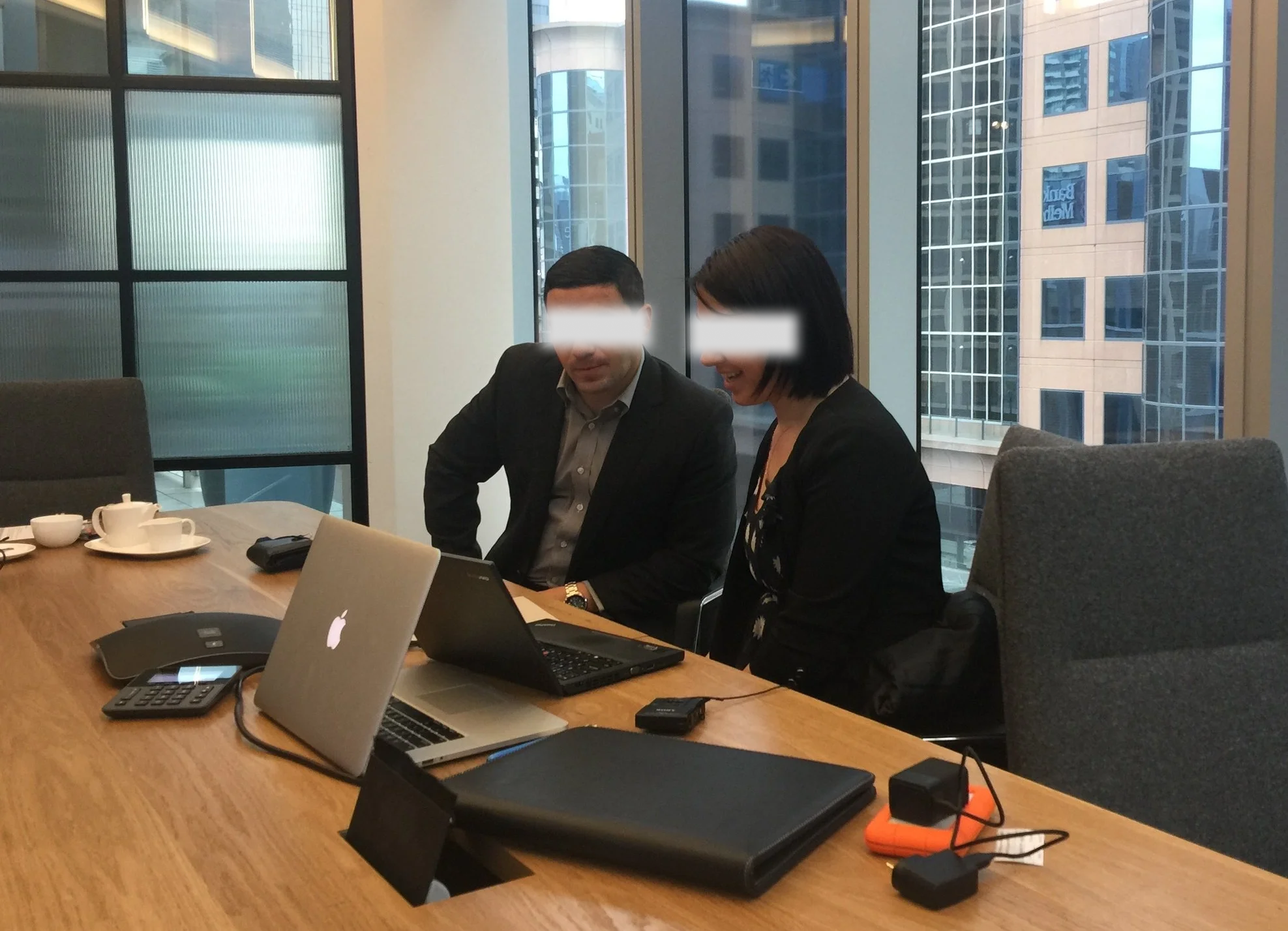
To facilitate a free flowing, natural discussion we tested the clickable OPA prototype with customers and bankers together in order to capture the nuanced insights that a shared experience offers.
With customers & bankers together, we created scenarios that were tailored towards a customer’s profile and that facilitated multiple product needs and different advice pathways. We rapidly iterated the prototype as we received feedbacks.Banker & project team workshops to capture business requirements, limitations and system capability.
What did we want to find out? How do customers perceive the different conversation pathways, as well as transiting between them.What do customers think about a side-by-side experience as well as the questions & information on the screen.Usability of the interface & interaction.How does the prototype influence the conversation or advice that bankers provide to customers.How effective are the legal and advice disclaimers.How do bankers currently use their tools to complete their tasks.Taxonomy; labelling, categorisation and language use.
Design of the Conversation model:
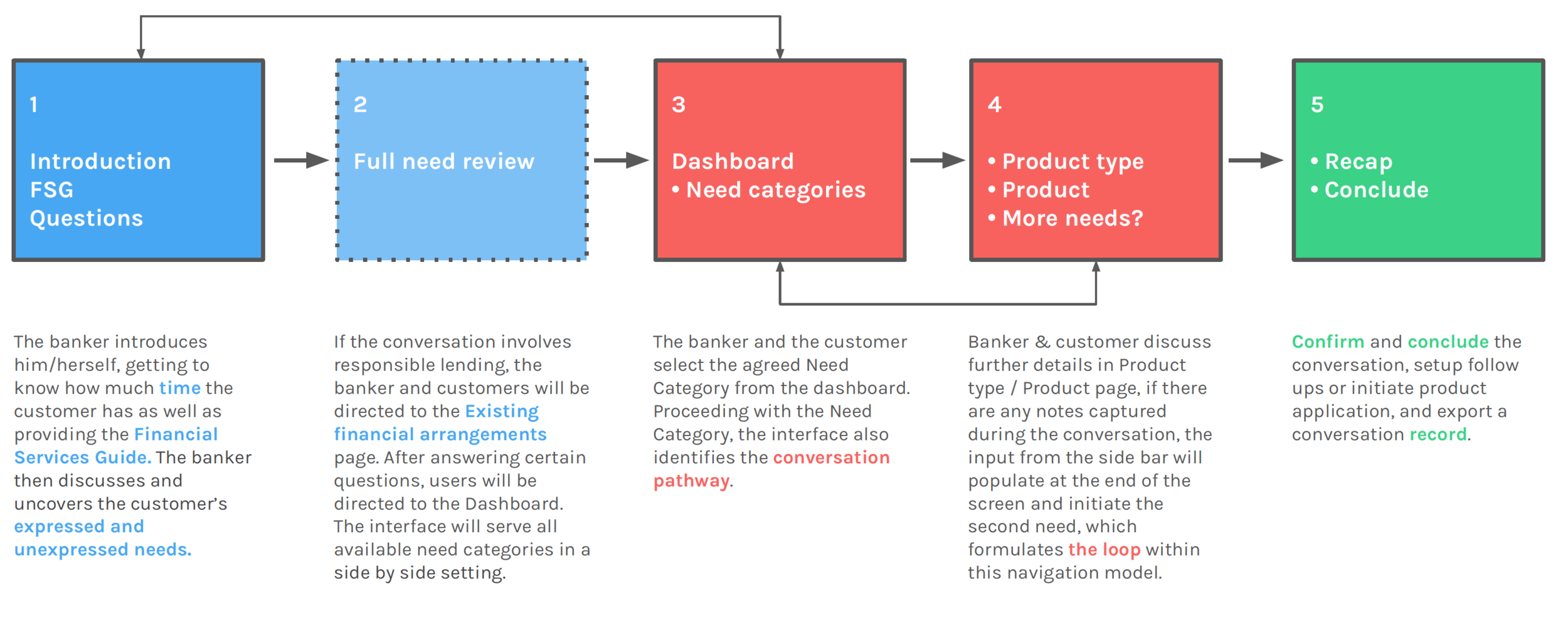
Conversation tool features
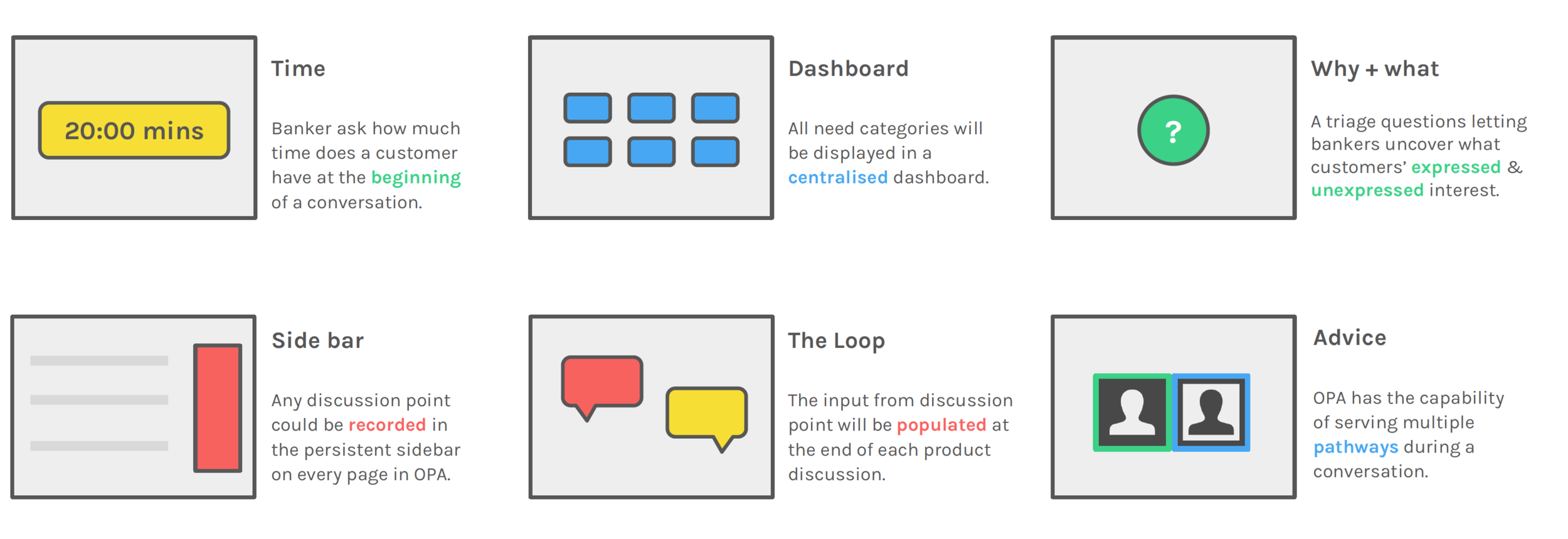
Conversation tool features
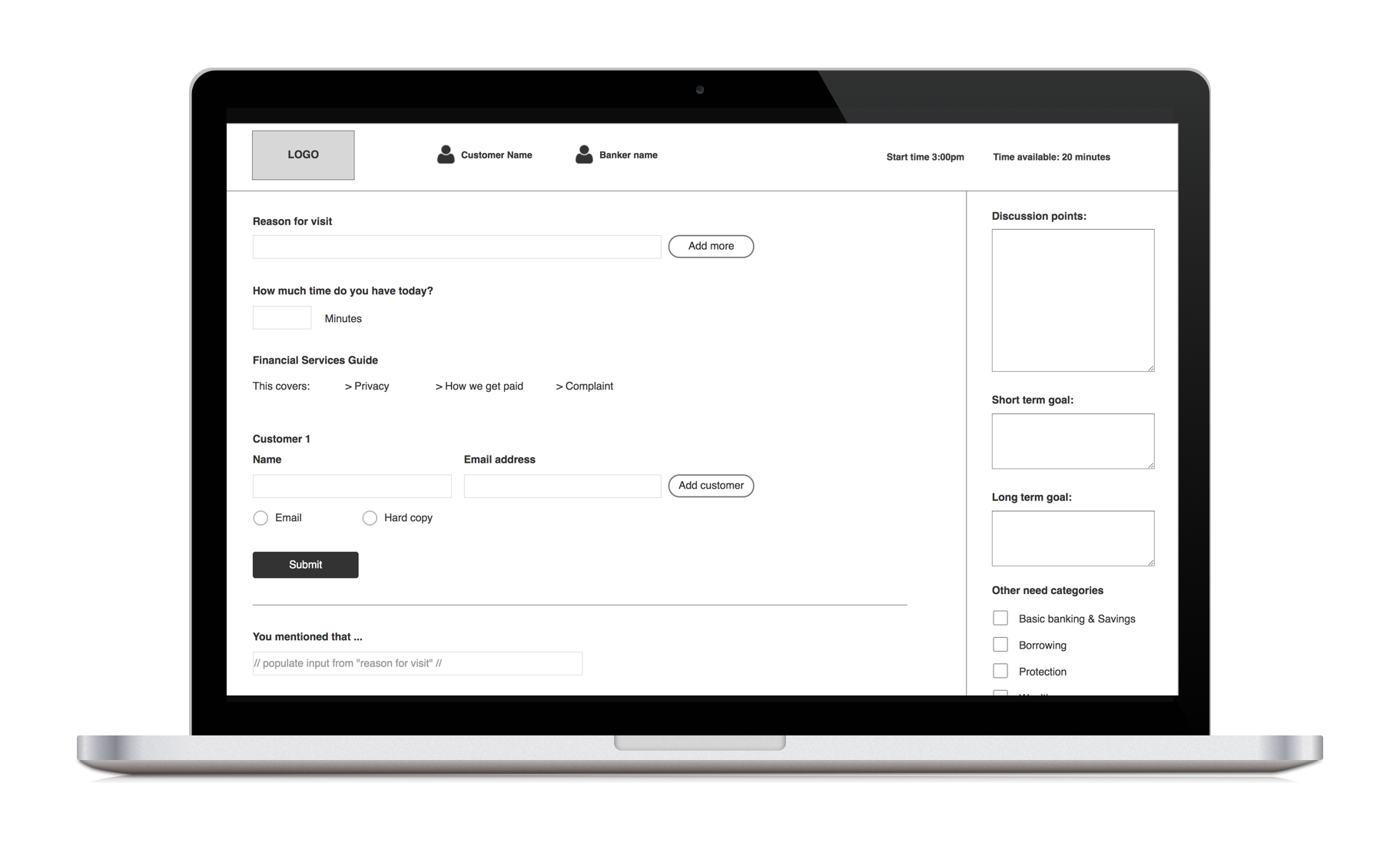
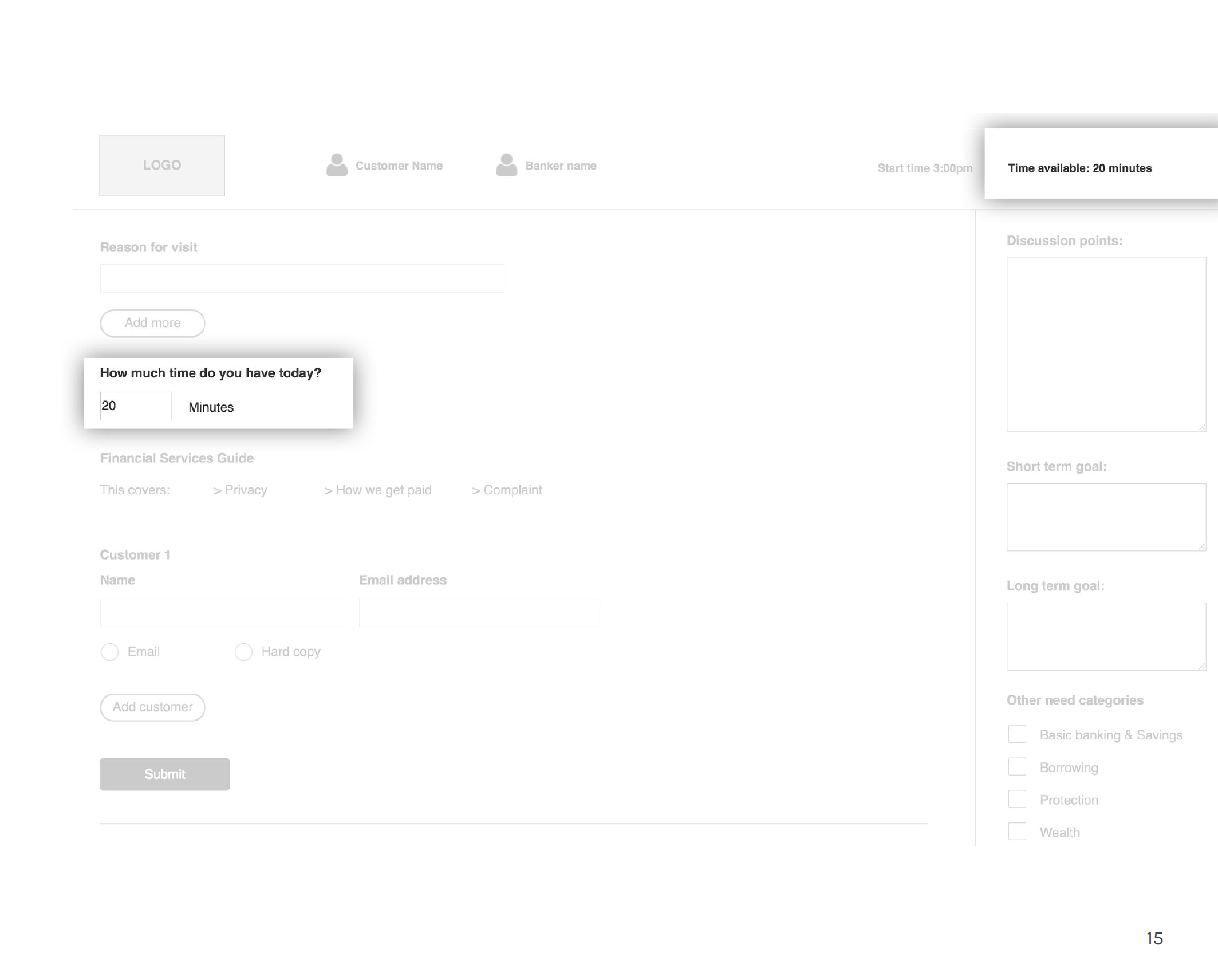
Timer
A customer friendly question to ensure that the service provided will satisfy the customers’ priorities and interests within the allocated timeframe. From our testing so far it is clear that customers like being asked how much time they have. They feel like they are being listened to and their time is valued.
"I liked that he asked me how much time I have. No one in
a branch has ever asked me that question." — Mel, Westpac Customer
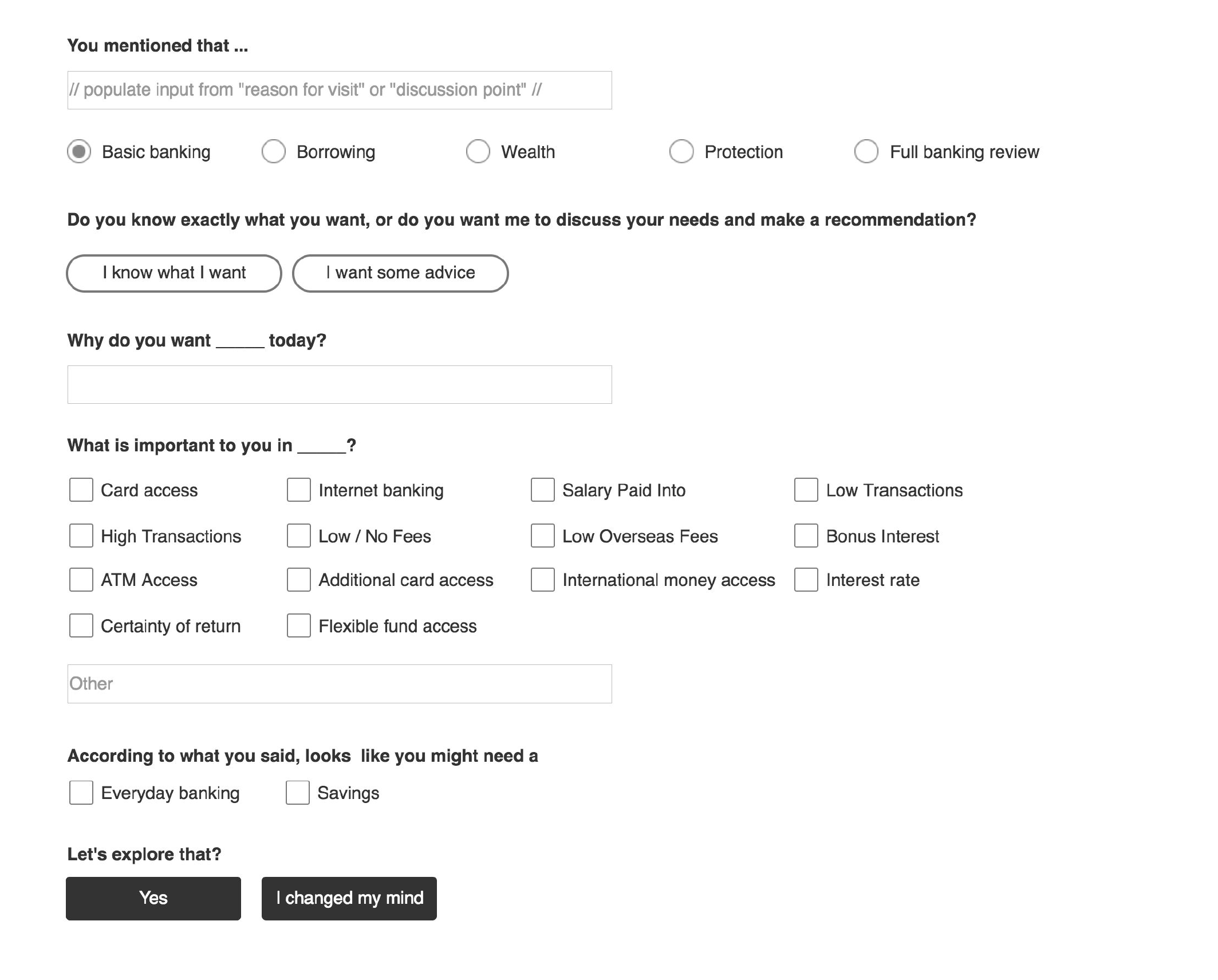
Why & What
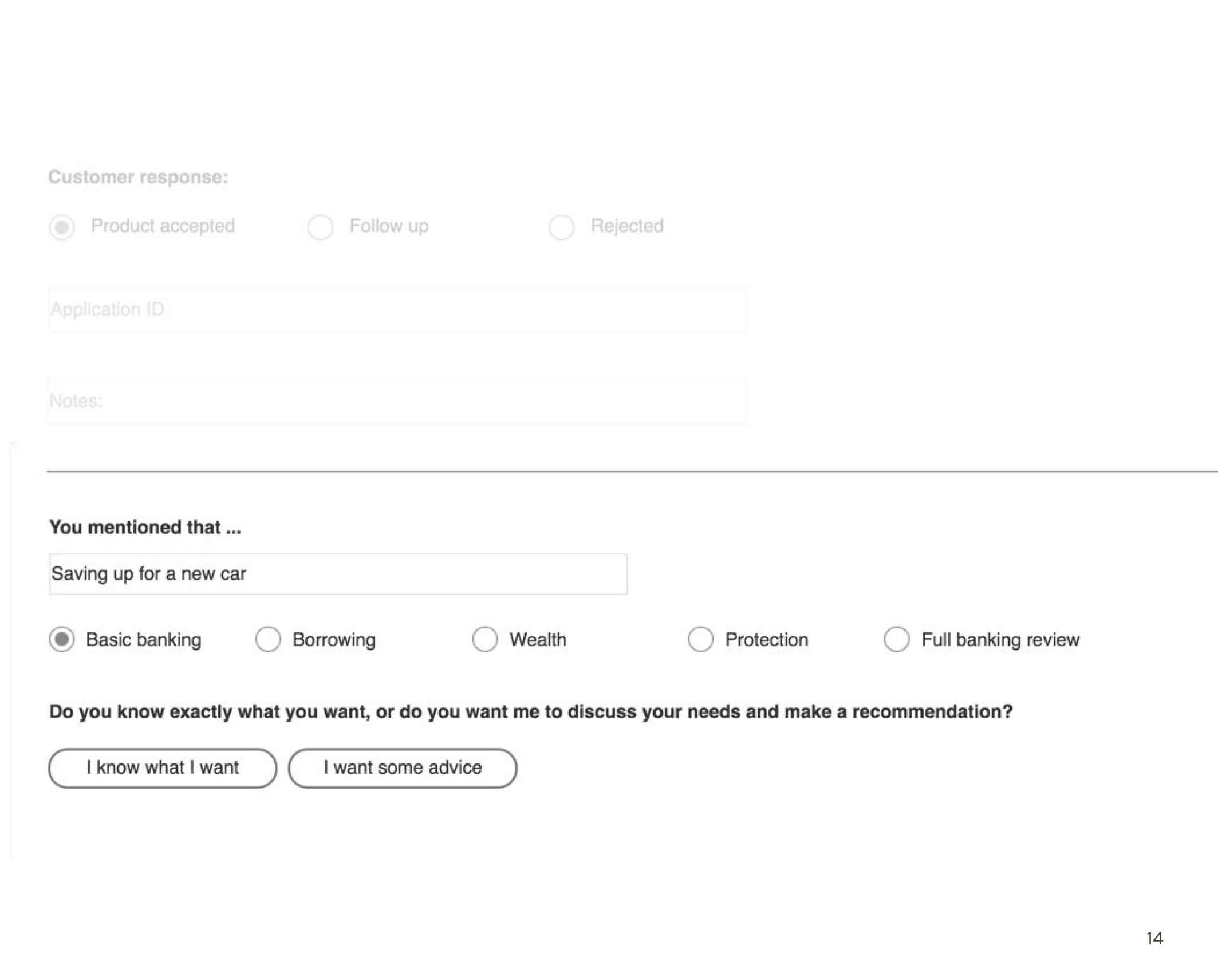
Clearly identify which category of products they should recommend to the customers.Asking why a customer wants a product and what they are looking to do with it gives the opportunity for both parties to establish the right product need.Furthermore, it helps a banker to uncover the implicit and explicit needs of a customer so that they can hone in on secondary needs that are relevant to the conversation at hand.
”If you don’t ask you may be setting up something that’s not suitable for the client.“
- Frank, Banker
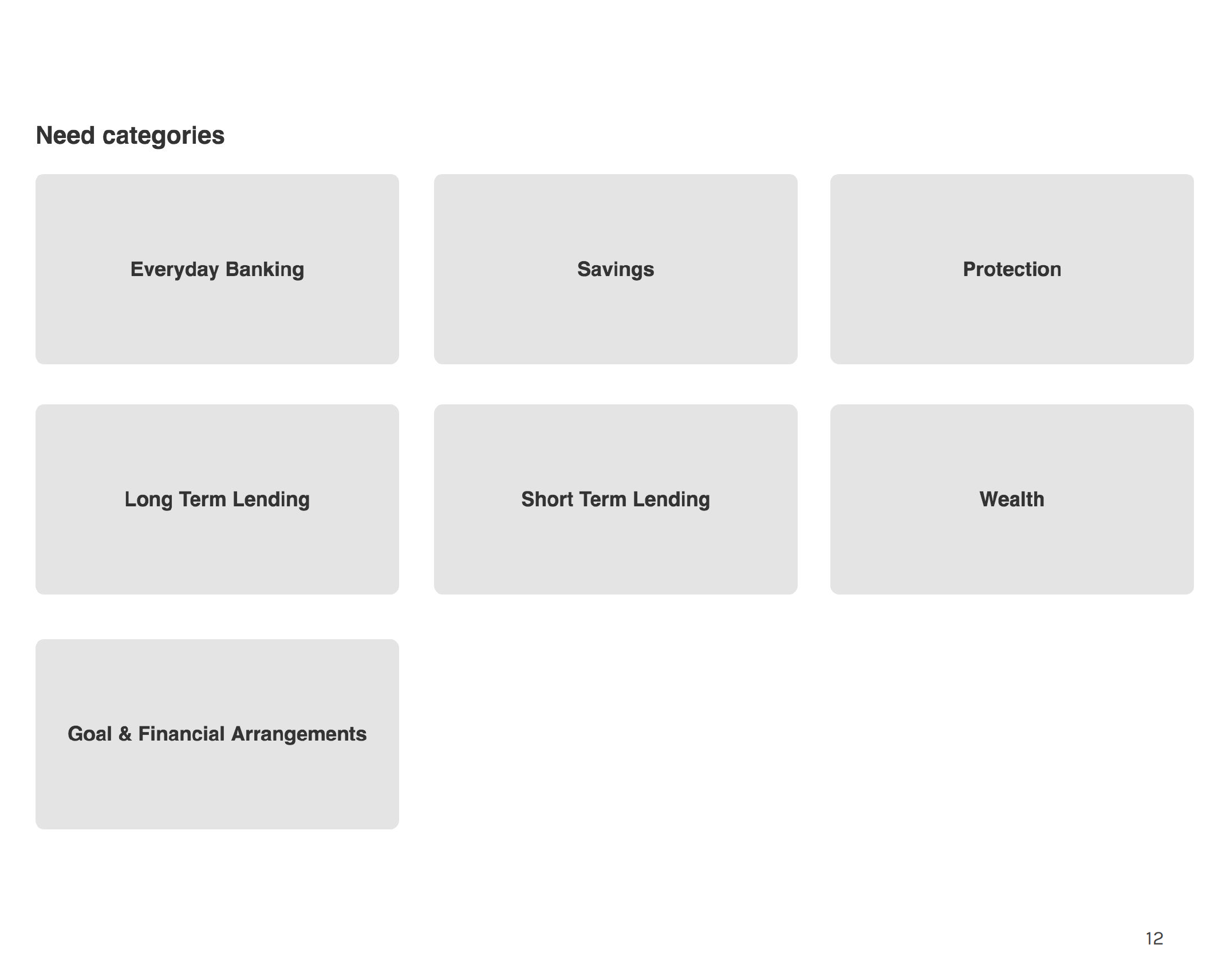
Dashboard
Options made available to both bankers and customers after discussing customers’ expressed and unexpressed interest. The dashboard is popular with most customers. It is simple, intuitive and piques customers curiosity about other product needs. It also appeals to customers who prefer prefer visual modes of representation.
"I could see how my query fitted into the products that Westpac offered"
— Con, Banker
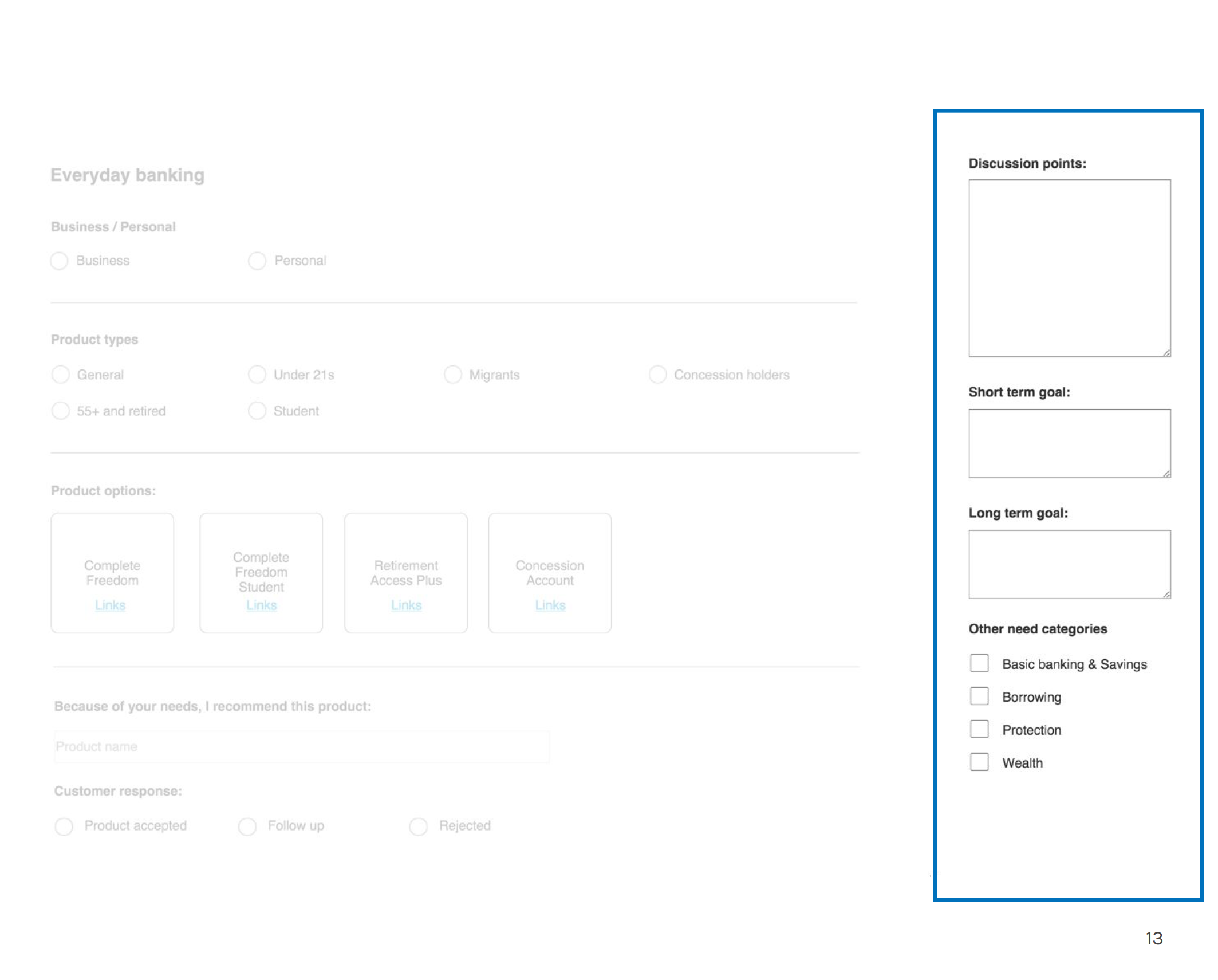
Side bar
A persistent side bar that is visible at all time allows bankers to capture customers’ needs and further opportunities outside of primary needs.Customers liked the notion of the banker being able to use the information to prompt a continuous conversation. Bankers liked the idea of a sidebar that moved with the conversation. It is seen as a big improvement on what is currently offered in the current systems.
"I liked the sidebar. With myCNR there’s 10-11 different screens and it’s not immediately obvious which screen to tab to. This can interrupt the conversation. The sidebar on this (the prototype) is literally on the screen that you’re on at the time."
— Andrew Urry, Banker
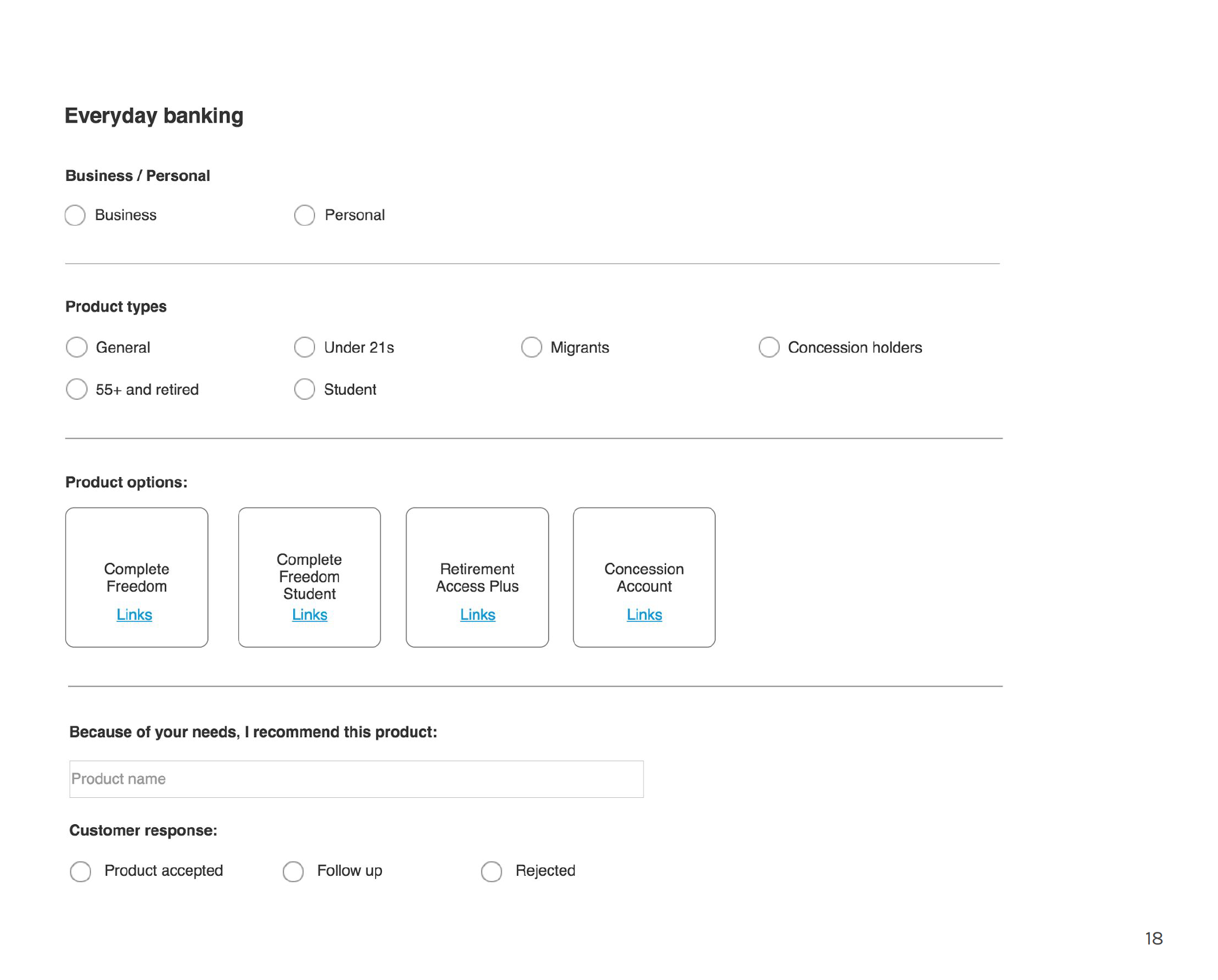
Product options
Both bankers and customers will have clearer idea of what the bank offers, also allowing them to easily compare the details by a linkage to customer facing content or webpages.
"When she brought up the Bank SA website..that’s familiar. I like that it’s going into something where you’ve done your own research."
— Cathy, Banker
The loop
Allow bankers to naturally follow up any further opportunities or needs that’s been mentioned during the conversation.
"My concern as a banker is reality. Systems crash, you’re busy, you’ve got clients back to back. My ultimate thing would be all the systems talked to each other so that you don’t have to retype it again in another application. I would love a system that’s streamlined so that I don’t have 17 applications open."
— Hana, Banker
Outcome
The benefits of a shared experience, Transparency
A customer being able to see the whole conversation as it happens on screen gives them the impression of greater transparency. They can see the banker inputting information into OPA and are able to point out mistakes if / when they occur. They are also able to read ahead and see what information the banker will ask in advance as well as read any disclaimers or information on the screen in detail. Rather than just receiving verbal information from a banker the information on screen is a prompt for a customer to converse and inquire.
More invested in the experience
Customers feel more invested in the experience because the conversation revolves around them and is a humanised face to face experience.
Thanks for the support from all the subject matter experts, who gave us so many valuable insights about banking. Through this project, I had the opportunities to listen to and learn from managers from different sectors, cross-functional teams at the bank. And I appreciated the bankers and customers for sharing their banking experience, personal stories during all the research sessions. They were passionate about providing helpful insights to help us arrive at a great design solution, to help to solve problems and improve the current service experience.
It was a successful delivery of the project, currently live in Westpac retail bank branches across Australia, being a helpful tool for Westpac bank customers and the banking staffs and employees. We received many positive feedbacks from service implementation and practise leads, stakeholders, also our users - which are bankers and customers throughout the process.